Agosto 23, 2025
|12 minuti di lettura

Your customer’s inbox is crowded. For B2B marketers, it’s the main place where you either get noticed or get deleted in seconds. For a long time, email has been the best way to get a return on your investment (ROI), and it still is—but it’s getting much harder to stand out. Your buyers, from the boss to the IT manager, are overwhelmed with emails. They are quick to delete anything that looks generic, and the old way of sending the same message to big lists of people no longer works. This is where Artificial Intelligence (AI) comes in.
AI in email marketing is about using smart technology to understand your customers on a deeper level and send them emails they actually want to read. Think of it as a very smart assistant for your marketing team. This assistant can look through huge amounts of customer information—like what they’ve clicked on, what they’ve bought, and who they are—to find patterns a person could never see. It then uses what it learns to help you automatically change your message, timing, and content for each individual. It’s the difference between shouting one message to a crowd and having a relevant, personal conversation with each customer, but on a huge scale. This is your simple guide for this new way of doing things. It’s for the B2B marketing leader who needs to make smart tech choices, the marketing strategist doing the day-to-day work, and anyone who knows the future of email isn’t just about automation—it’s about intelligence. Table of Contents
Integrating AI isn’t just about using new technology; it’s about gaining a significant competitive edge. The core advantages are clear, direct, and impact every level of your marketing efforts. 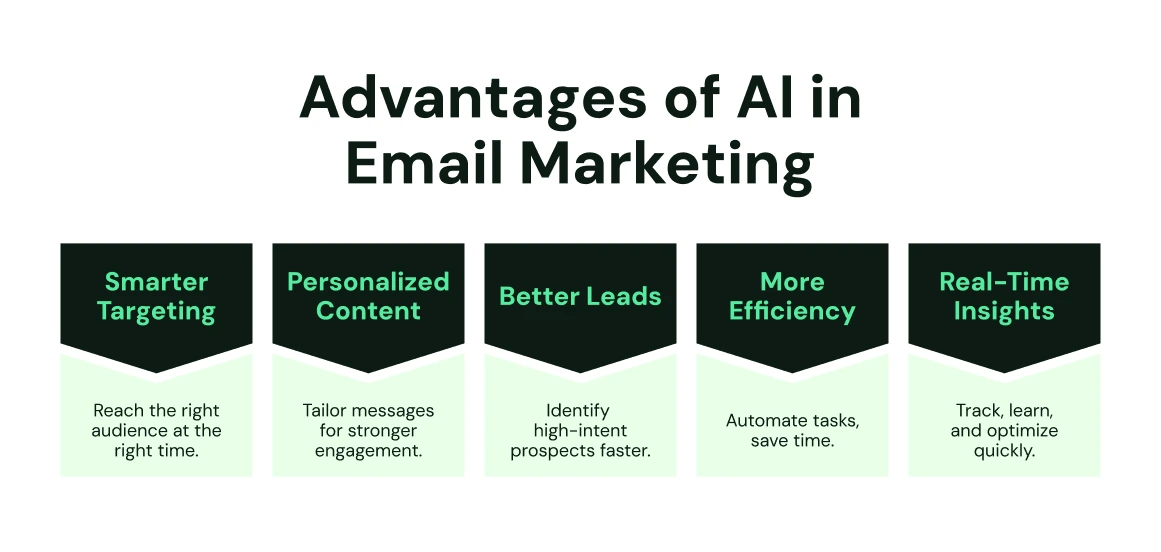 Deeper Customer Connection: AI moves you beyond generic communication. By tailoring content to individual needs and behaviors, you create emails that feel more relevant and personal, strengthening brand loyalty. Higher Quality Leads for Sales: Instead of sending every lead to sales, AI’s predictive scoring identifies who is ready to buy. This means your sales team spends less time chasing dead ends and more time closing deals with high-intent prospects. Increased Team Efficiency: AI automates the most time-consuming parts of email marketing, like list segmentation, A/B testing, and drafting routine copy. This frees your talented team to focus on strategy, creativity, and high-impact projects. Better, Faster Decision Making: AI provides data-backed insights into what’s working and what isn’t. This allows you to stop guessing and start making strategic decisions based on real-time performance data, optimizing your campaigns for success.
AI’s impact isn’t a single feature; it’s a fundamental upgrade to your entire email marketing engine. It’s about moving from educated guesses to data-driven certainty. Let’s dissect the key areas where this transformation is happening.
Per molto tempo, “personalization” significava solo aggiungere il nome di una persona in una email. Adesso è molto di più. L’IA ti permette di andare ben oltre e di avere vere conversazioni one-to-one.
Lo stile vecchio era raggruppare i contatti in grandi contenitori. Il nuovo modo è permettere all’IA di costruire segmenti dinamici, micro-segmenti in tempo reale. Invece di guardare solo a dati aziendali come dimensione azienda o settore, l’IA analizza una ricca tavolozza di dati per trovare modelli che non vedresti da solo (MarTech). Questo include: Behavioral Data: Chi sta cliccando su cosa? Quali whitepapers hanno scaricato? Quali pagine del tuo sito hanno visitato? L’IA collega questi punti per rivelare l’intento reale. Technographic Data: Qual è lo stack tecnologico che l’account target usa già? Sapere che usano un prodotto concorrente o una tecnologia complementare consente messaggi incredibilmente mirati.
Questo è il punto in cui la capacità di segmentazione dell’IA prende vita. Invece di creare una dozzina di versioni email, crei un unico modello smart. L’IA quindi popola quel modello con i contenuti più rilevanti per ciascun destinatario mentre lo aprono (MarTech). Immagina un’email inviata a più stakeholder in un account target:
Questo non è solo in termini di personalizzazione; è un’esperienza personalizzata, fornita su una scala che sarebbe impossibile per qualsiasi team umano gestire manualmente.
Il miglior marketing sembra prevedere il futuro. L’IA ti offre uno strumento che ti aiuta a prevedere cosa faranno i clienti successivamente guardando a ciò che hanno fatto in passato.
Dimentica i vecchi sistemi in cui indovini quali lead sono buoni. Quel modello non funziona più bene. L’IA osserva tutti i tuoi vecchi clienti che hanno effettuato un acquisto e impara cosa avevano in comune. Quindi assegna ai nuovi lead un punteggio basato su quanto è probabile che acquistino. Questo aiuta il tuo team di vendita a smettere di sprecare tempo e a concentrarsi sulle migliori opportunità (Salesforce).
Quando è il momento migliore per inviare un’email? Le tue supposizioni non sono sufficienti. Gli strumenti IA possono determinare il momento perfetto per ogni contatto della tua lista. Osservando quando hanno aperto le tue email in passato, il sistema invia il messaggio nel momento in cui è più probabile che appaia nella loro casella di posta (OrangeOwl; Mailchimp).
Per i modelli SaaS B2B e in abbonamento, la retention è tutto. L’IA può monitorare sottili cambiamenti nell’engagement delle email—a slow decline in open rates, a lack of clicks over several weeks—to flag an account as “at-risk” long before they cancel. Questo offre al tuo team di successo del cliente una finestra critica per intervenire. Allo stesso tempo, l’IA può analizzare i profili dei tuoi clienti di maggior valore e di lungo periodo e costruire “lookalike” audiences di nuovi prospect che condividono quelle stesse caratteristiche vincenti (Salesforce).
Generative AI è il moltiplicatore della forza creativa che il tuo team stava aspettando. È qui per eliminare il blocco dello scrittore, automatizzare test noiosi e assicurare che la voce del tuo marchio rimanga potente e coerente.
Il tuo oggetto è la chiave per l’intero messaggio. Ha un solo compito: far aprire l’email. Invece di far brainstorming al tuo team su alcune opzioni, l’IA generativa può produrre decine di variazioni accattivanti in pochi secondi. Ma c’è di più. Piattaforme più avanzate combinano questo con analisi predittiva per prevedere quale oggetto funzionerà meglio con un determinato segmento di pubblico, permettendoti di eseguire test iper-efficienti che producono risultati immediati (OrangeOwl; Mailchimp).
Inquadra l’IA come assistente creativo. Può:
This frees your human copywriters to do what they do best: high-level strategy, final polishing, and infusing the copy with the kind of human empathy AI can’t replicate. Furthermore, AI tools can analyze your drafts to ensure they align with your established brand guidelines, flagging a tone that’s too casual or a phrase that’s off-brand before it ever reaches a customer.
Adopting AI isn’t about flipping a switch. It’s a strategic shift that demands a thoughtful approach to protect your brand and your data. This section covers the keychallenges and the best practices to overcome them. 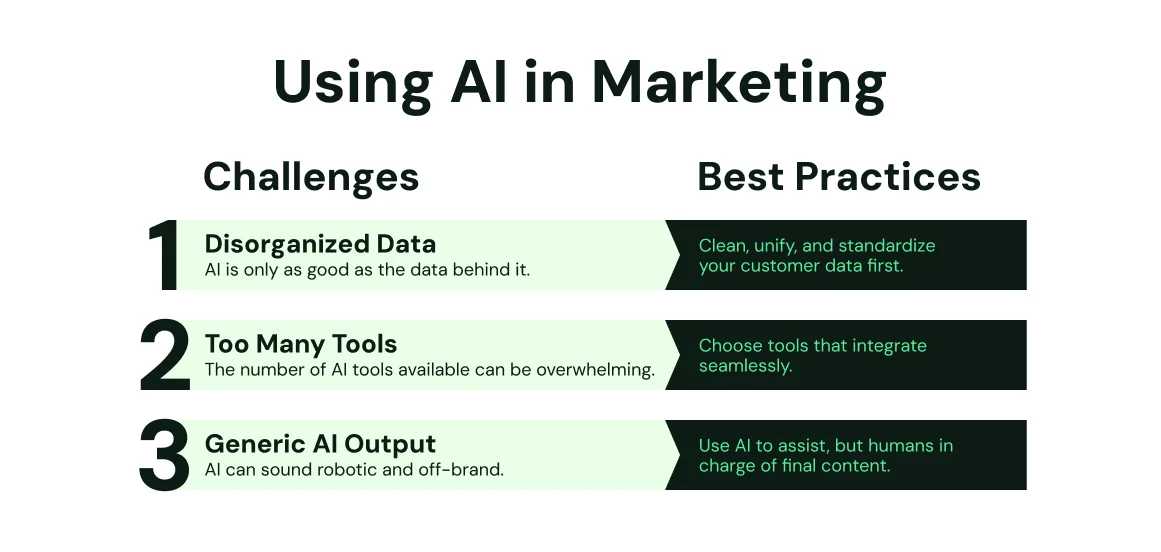
Messy and Siloed Data: Dati disordinati e isolati: Let’s be blunt: AI is only as smart as the data you feed it. The biggest challenge for many teams is a customer database that is disorganized, incomplete, and spread across multiple systems. If your data is a mess, your AI will produce messy results.
Choosing the Right Tools in a Crowded Market: Il panorama martech è inondata di strumenti IA, e può essere scoraggiante distinguere segnale dal rumore.
The Fear of Robotic, Off-Brand Content: La paura di contenuti robotici, fuori marchio è valida, ma evitabile. The biggest mistake you can make is to treat AI as a “set it and forget it” solution. The fear of AI producing generic, soulless content is valid, but it’s also entirely avoidable.
Il ROI è più della semplice apertura e tassi di clic—la tua leadership vuole vedere un impatto aziendale misurabile. Ecco come l’IA genera direttamente ritorni:
AI-powered lead scoring filters out low-interest contacts, allowing sales teams to focus on high-quality leads. For example, by tracking behavior across emails, landing pages, and product pages, AI can identify hot leads more accurately. This helps improve the MQL to SQL conversion rate.
AI helps reduce the time it takes to move leads through the sales funnel. Predictive analytics and automated nurturing deliver timely, relevant content that keeps prospects engaged and progressing faster.
AI enables you to predict churn, identify upsell opportunities, and deliver targeted retention campaigns. Customers stay longer, buy more often, and spend more per transaction.
Quando contenuto email corrisponde alle preferenze del cliente, le conversioni aumentano. Le raccomandazioni di prodotto generate dall’IA e messaggi personalizzati possono aumentare significativamente i tassi di clic. Secondo uno studio, la personalizzazione delle email tramite IA può aumentare il fatturato delle email del 41% in un anno. (Salesforce)
L’IA automatizza compiti che richiedono molto tempo, come i test A/B, la segmentazione e il tracciamento delle prestazioni. Ciò consente ai team di reinvestire tempo in strategia, innovazione e pensiero creativo, riducendo i costi senza compromettere la produzione.
Attingendo a piattaforme di dati cliente (CDP), l’IA può attingere insight da email, web e storie di acquisto. Questa visione unificata rende la segmentazione più efficace e il targeting più preciso. In breve, l’IA non ti aiuta solo a inviare email migliori—ti aiuta a costruire un motore di marketing più efficiente, redditizio e pronto per il futuro.
AI can enhance your email content by enabling personalized messaging at scale. For instance, a retailer can create one base email and then use AI to generate multiple versions that cater to different customer segments based on past behavior, preferences, and browsing activity. With the help of historical data from your CRM, you can integrate dynamic content such as product recommendations, promotional offers, or personalized subject lines. AI systems can then monitor how each customer engages and deliver the next best message to keep the conversation going. This smart automation not only saves time but also helps you build more meaningful connections with customers. It streamlines the entire content creation process while making your messages feel more human and relevant.
AI is not just another automation tool—it’s evolving into a strategic co-pilot for modern marketers. Its capabilities are expanding fast, and in the next few years, we’ll see email campaigns that are:
For example, Deloitte reports that 62% of marketing leaders now use AI to tailor content in real time (“The State of Generative AI in the Enterprise”). That means your customers are increasingly receiving messages shaped by algorithms. In the future, AI will:
Most importantly, AI will help you build trust. With a rising focus on first-party data, marketers must engage users meaningfully and ethically. AI helps you use data more responsibly by showing only relevant, personalized messages, leading to improved customer loyalty and fewer unsubscribes. By 2026, it’s expected that 80% of customer interactions will be managed by AI, yet appear human-led (Gartner). To succeed, marketing teams will need to understand AI, not just use it. That means marketers who know how to brief, QA, and iterate with AI will have the edge.
AI email marketing isn’t just a trend. It’s a smarter way to:
Start small. Try AI for segmenting lists or optimizing send times. As you get more comfortable, expand to personalization and performance tracking. AI emails work. It’s intelligent, it’s personal, and it’s waiting for you to lead the way. Works Cited
Please enter your email address so we can send you a one-time pass code and verify if you are an existing subscriber.
 IT
IT 

 IT
IT